


EXPLORE.PERSIST.MASTER.
CCNP Wireless Certification and Training.
Share :
+971 43346660
IPRULERS is emerging as a leading destination for CCNP Wireless certification and training in Dubai, UAE, offering both online and classroom-based learning focused on modern wireless networking technologies and enterprise mobility solutions. Our training programs are designed to provide deep technical understanding of wireless infrastructure, design, deployment, and troubleshooting within enterprise environments.
With group sessions as well as personalized one-to-one training, students can choose schedules that suit their availability, including weekday and weekend batches. The program allows learners to build strong expertise in wireless networking technologies while preparing for industry-recognized Cisco certifications. Through structured training, expert mentorship, and practical lab exposure, IPRULERS continues to support professionals in advancing their careers in the evolving field of enterprise wireless networking.
Target Audience:
- Network engineers who want to deepen their expertise in enterprise wireless technologies and advance their professional capabilities.
- IT students and professionals seeking strong technical knowledge along with an internationally recognized Cisco certification to strengthen their career prospects.
- Professionals planning to build careers in enterprise wireless networking, infrastructure design, and mobility solutions.
Individuals aspiring for roles such as:
Network Engineer
Wireless Network Engineer
Network Administrator
Network Designer
Consulting Systems Engineer
Technical Solutions Architect
Network Manager
- IT professionals working with Cisco technologies, system integrators, and network solution partners who wish to enhance their wireless deployment and troubleshooting skills.
Prerequisites:
- There are no mandatory prerequisites to attend the CCNP Wireless training program. However, participants should have a solid understanding of networking fundamentals.
- Prior knowledge equivalent to CCNA-level networking concepts is recommended for better understanding of enterprise wireless technologies.
- Practical experience in network administration, wireless infrastructure, or enterprise networking environments will be beneficial when preparing for the certification examination.
- Earn an internationally recognized Cisco certification that validates advanced expertise in enterprise wireless networking.
- Gain specialist certification by passing any CCNP wireless core or concentration examination.
- Become eligible to attempt the CCIE Enterprise Wireless Lab Exam by successfully completing the CCNP core examination.
- Stay aligned with evolving wireless technologies, mobility solutions, and enterprise network architectures.
Duration
70
Skill Level
Intermediate
Certificate
Yes
Modules
3
Language
English
Mode
Online/Offline
Key Highlights
- Live Instructor-Led Training (Online & Classroom)
- 40 Hours of Technology Lectures
- Weekdays (Tue - Fri)
- Weekend (Fri-Sat or Sat-Sun)
- SD-Access Lab (DNA center with 9300 series switch)
- Cisco Catalyst SD-WAN Lab (Cisco Viptela Infra)
- Real Equipment and Real World Live Scenarios
- Exam question bank and Preparation
Key Highlights
- 24/7 Access to the Learning Resources
- 100% Pass Guarantee
- Hands-on Lab Practice on physical equipment
- Flexible Installment Plans
- Boot Camp Training for a Fast Track Learning
- The Only Center in the UAE with SDN Lab Infra
- Eve-ng Set up on the laptop with images
- Demand-driven recorded video lectures for references
Course Curriculam
RF Fundamentals (10%)
- Describe device virtualization technologies
- Describe RF signal measurements.
- Signal strength (RSSI, transmit power, receive sensitivity)
- Interference, noise, rogue AP
- Device capabilities (smartphones, laptops, tablets)
- SNR
- Describe the principles of RF mathematics
- Describe Wi-Fi antenna characteristics
802.11 Technology Fundamentals (10%)
- Describe Wi-Fi governance
- Regional regulatory bodies
- IEEE 802.11
- Wi-Fi Alliance
- Describe usable channel and power combination
- Regional EIRP limitation examples
- Frequency bands
- RRM fundamental
- Describe 802.11 fundamentals
- Modulation techniques
- Channel width
- MIMO / MU-MIMO / MLO
- Wireless topologies
- Frame types
Wireless Network Implementation (10%)
- Describe Cisco wireless architectures
- Fabric
- Mesh
- Local
- Cloud
- Implement the physical infrastructure connections for a wireless network and components
- Implement the AP, WLC, and dashboard management access connections
Wireless Network Operation (20%)
- Configure the initial setup of Cisco wireless infrastructures
- Implement AP discovery and join process
- Implement AP modes
- Configure WLAN access for client connectivity
- Configure client management rules and policies on multiple platforms such as WLC, Dashboard, Catalyst Center, ISE, Spaces, and mobile device management
Client Connectivity Configuration (20%)
- Configure authentication mechanisms outside the controller
- Configure WLAN authentication mechanisms on the controller
- Configure client connectivity in different operating systems
- Describe roaming
- Configure wireless guest networking
Wireless Monitoring and Management (15%)
- Manage wireless network maintenance
- Configure client monitoring
- Troubleshoot client connectivity
- Describe device and platform integrations
Automation and AI (10%)
- Interpret basic Python components and scripts
- Describe NETCONF/YANG
- Interpret wireless infrastructure APIs
- Describe AI Analytics in Catalyst Center
- Describe AI Operations in Catalyst Center
- Describe AI-RRM
Wireless Site Survey (25%)
- Collect design requirements and evaluate constraints
- Client density
- Real-time applications
- AP type (including antenna type)
- Deployment type (data, location, voice, video)
- Security
- Describe material attenuation and its effect on wireless design
- Perform and analyze a Layer 1 site survey
- Perform a pre-deployment site survey
- Perform a post deployment site survey
- Perform a predictive site survey
- Utilize planning tools and evaluate key network metrics (Ekahau, Hamina, Chanalyzer, Spectrum Analyzer)
Wired and Wireless Infrastructure (30%)
- Determine physical infrastructure requirements such as AP power, cabling, switch port capacity, mounting, and grounding
- Determine logical infrastructure requirements such as WLC/AP licensing requirements based on the type of wireless architecture
- Design radio management
- RRM (Including Cisco Catalyst Center AI-Enhanced RRM)
- RF/Radio profiles
- RxSOP
- Apply design requirements for these types of wireless networks
- Data
- Voice and video
- Location (including Cisco Spaces)
- Design high-density wireless networks and their associated components
- Design wireless bridging (mesh)
- Modes of operation
- Ethernet bridging
- WGB and roaming
Mobility (25%)
- Design mobility groups based on mobility roles
- Optimize client roaming
- Validate mobility tunneling for data and control path
- Describe Site Tags
WLAN High Availability (20%)
- Design high availability for controllers
- Network availability through LAG
- Stateful Switchover (SSO)
- Controller priority and redundancy (including Anchor)
- Design high availability for APs
- AP prioritization
- Fall-back (assigning primary, secondary, and tertiary)
- Embedded Wireless Controller (EWC)
FlexConnect (15%)
- Deploy FlexConnect components such as switching and operating modes
- Deploy FlexConnect capabilities
- FlexConnect groups and roaming
- Split tunneling and fault tolerance
- VLAN-based central switching and Flex ACL
- Smart AP image upgrade
- Implement Office Extend
QoS on a Wireless Network (10%)
- Implement QoS schemes based on requirements including wired to wireless mapping
- Implement QoS for wireless clients
- Implement AVC
Multicast (10%)
- Implement multicast components
- Describe how multicast can affect wireless networks
- Implement multicast on a WLAN
- Implement mDNS
- Implement Multicast Direct
Location Services (10%)
- Deploy CMX and Cisco Spaces on a wireless network
- Implement location services
- client tracking
- RFID tags (tracking only)
- Interferers
- Rogue APs
- Clients
Advanced Location Services (10%)
- Implement CMX and Cisco Spaces components
- Detect and locate
- Analytics
- Presence services
- Captive portals
- Connectors
- Implement location-aware guest services using custom portal and social media Wi-Fi
- Troubleshoot location accuracy
- Troubleshoot CMX and Cisco Spaces Connector high availability
- Implement wIPS using Cisco Catalyst Center (formerly Cisco DNA Center)
Security for Wireless Client Connectivity (20%)
- Configure client profiling on WLC and ISE
- Implement BYOD and guest
- CWA using ISE (including self-registration portal)
- LWA using ISE or WLC
- Native supplicant provisioning using ISE
- Certificate provisioning on the controller
- Implement client security on different wireless architectures and ISE
- Implement Identity-Based Networking on different wireless architectures (VLANs, QoS, ACLs)
Monitoring (15%)
- Utilize reports on Cisco Catalyst Center
- Manage alarms and rogues (APs and clients)
- WLC
- Cisco Catalyst Center
- Manage RF interferers
- WLC
- Cisco Catalyst Center
- Troubleshoot client connectivity
- WLC
- ISE
- Cisco Catalyst Center
Device Hardening (10%)
- Implement device access controls (including RADIUS and TACACS+)
- Implement access point authentication (including 802.1X)
- Implement Control Plane ACLs on the controller
lab infrastructure.
IPRULERS offers a fully equipped lab specifically designed for CCNP Wireless training, featuring an advanced lab topology that mirrors real-world network environments. Students will have access to a range of configured equipment and software for hands-on practice, with opportunities to explore the latest hardware and
software updates during the course

CCNP WIRELESS EQUIPMENT AND SOFTWARE LIST

The practical exam tests candidates on solutions that can be configured using the below Equipment and software versions. Candidates may see more recent software versions during their attempt but will only be tested on features that are supported in the list below. Passing the exam requires a depth of understanding difficult to obtain without hands-on experience.
Early in your preparation you should arrange access to equipment and software similar to
that used on the exam
Virtual Infrastructure
- Cisco Catalyst Center — 2.3.x
- Cisco Identity Services Engine (Cisco ISE) — 3.4.x
- Windows Server (no candidate configuration required)
- Wireless clients (Linux/Windows 11) with Cisco Secure Client

Physical Equipment
- Cisco Catalyst Wireless 9100 Series
- Cisco Catalyst 9800 Series Wireless Controllers
- Cisco Campus Gateway
- Cisco Embedded Wireless Controller (EWC) on Catalyst Switches (SD-Access)
- Cisco Catalyst 9300 Series
- Cisco Catalyst 9200 Series
Modes Of Training
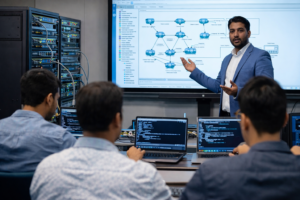
We provide various modes of training, each catering to different learning styles, preferences, and needs.You can make your choice of training mode.
- Classroom-Based Training
- One-On-One Training
- Online Training
- Corporate Training
- Fast Track Training
- Private Group Training
- Lab Workshop Training
Instructors

Gigi Vikraman
MD & Founder
4XCCIE (R&S, Security, Collaboration, DC), PCNSE & NSE7
2xCCIE (EI, Security), Microsoft, Amazon Web Services
Amal Raj is a CCIE-certified professional in Enterprise Infrastructure and Security with over 5 years of experience in consulting and training IT professionals in advanced networking and cybersecurity technologies. In addition to Cisco technologies, Amal possesses strong working knowledge of Microsoft and Amazon cloud platforms, enabling him to deliver comprehensive training across modern enterprise networking, security, and cloud environments

Amal Raj
Senior Technical Instructor


